
Nano Extraction vs Traditional Grinding: The Measured Difference
Tong Xin Yuan nano-extracted porcupine date powder was submitted to an independent laboratory and analysed by Dynamic Light Scattering under ISO 22412:2017. The measured hydrodynamic diameter was 122.73 nm, with the main intensity peak at 96.67 nm (94.91% of the distribution). Traditionally ground porcupine date powder typically falls between 100,000 and 500,000 nm — three to four orders of magnitude coarser.
1. The measured data
These are not estimates — they are the figures on the laboratory report. Testing was performed in April 2026 on Tong Xin Yuan porcupine date powder (TXY Jian Zhu Zao Powder), submitted by Xin Juan Enterprise Sdn Bhd.
| Measurement | Result |
|---|---|
| Method | Dynamic Light Scattering (DLS) |
| Reference standard | ISO 22412:2017 particle size analysis |
| Hydrodynamic diameter (Z-average) | 122.73 nm |
| Main intensity peak (Peak 1) | 96.67 nm (94.91% of area, SD 24.34 nm) |
| Secondary peak (Peak 2) | 1.15 nm (5.09% of area) |
| Polydispersity index (PDI) | 22.0% |
| Dispersant / temperature | Ethanol / 25.0 °C |
| Date of test | April 2026 |
2. How small is that, really?
A nanometre is one billionth of a metre. On its own, 122.73 nm means little. In comparison it means a lot:
| Subject | Approximate size | Note |
|---|---|---|
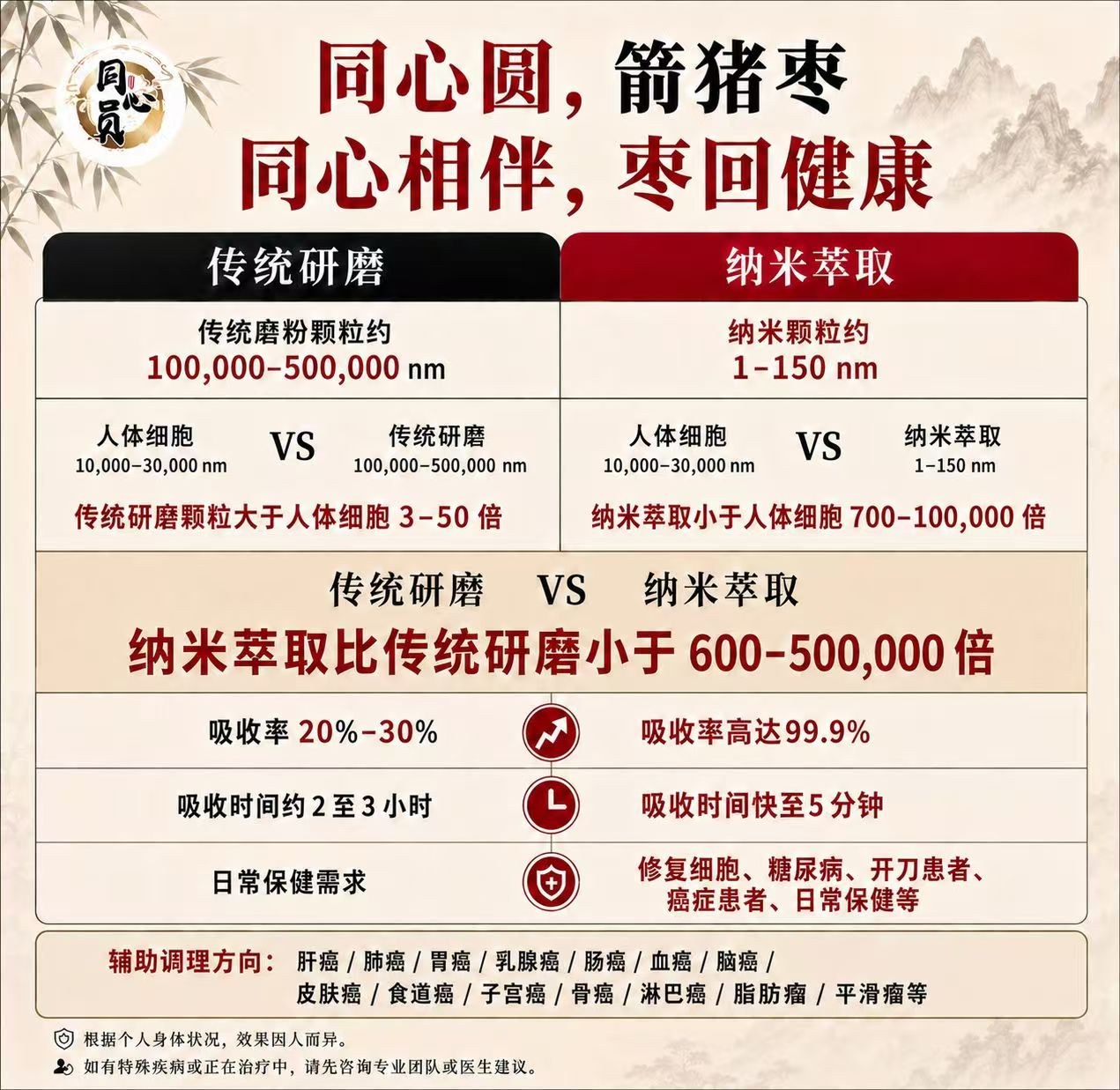
| Tong Xin Yuan nano extraction | approx. 1–150 nm | Measured: main peak 96.67 nm, Z-average 122.73 nm |
| Human cell | 10,000–30,000 nm | Typical size range for human cells |
| Traditionally ground powder | 100,000–500,000 nm | 0.1–0.5 mm, the usual range for conventional milling |
- Traditionally ground particles are 3 to 50 times larger than a human cell.
- Nano-extracted particles are hundreds to tens of thousands of times smaller than a human cell.
- Between the two processes, the difference is roughly three to four orders of magnitude.
3. Why particle size matters at all
The value of porcupine bezoar lies in its active constituents — tannins, β-sitosterol, bromelain and a range of amino acids. However good those constituents are, they only matter if the body can get at them.
The finer the particle, the greater the total surface area for the same weight, and the more of it meets digestive fluid. That is basic physics of dissolution rate. With coarse particles, the core of each grain may pass through before it has released anything at all. It is also why the nano-extracted grade is taken in smaller quantities than the traditional powder.
For the published research on the constituents themselves, see Porcupine bezoar active compounds: the published research.
4. Which one should you choose
Neither process is simply better. They differ in purpose and in budget.
| Traditional grinding | Nano extraction | |
|---|---|---|
| Particle size | Coarser (typically 0.1–0.5 mm range) | Measured 122.73 nm (Z-average) |
| Quantity per serving | Higher | Lower |
| Price per gram | Lower | Higher |
| Cost of a full course | Depends on quantity used | Less used per serving, so not necessarily more |
| Suits | Everyday use, gentle long-term routine | Those wanting higher efficiency per gram |
For actual prices and weight options, see the product range. The nano grade itself is described on Nano extract porcupine dates.
5. What we are not claiming
Marketing around nanotechnology often runs well ahead of the evidence. To be clear about the limits of this data:
- A particle size test proves how fine the particles are. It does not prove absorption rate, absorption speed, or any health outcome. This report measured size, not what happens in the body.
- Porcupine dates are a traditional edible product, not a medicine, and do not replace any medical treatment.
- If you are under treatment or managing a specific condition, speak to your doctor before taking anything.
On telling genuine bezoar from imitation, see Real vs fake porcupine dates.
Frequently asked questions
What is the measured particle size of Tong Xin Yuan nano extraction?
Is this a certification?
Does nano extraction really absorb better?
Did you test the traditionally ground powder too?
The nano grade costs more per gram. Is it worth it?
Want to see the full test report?
We can send you the particle size report and product details, and work out the cost comparison for the quantity you need.
Ask us on WhatsApp